
Most lip sores heal on their own within one to two weeks. A minor bite injury, a cold sore triggered by stress, a small irritation from a rough food — these are common, and they resolve without intervention. The ones that don’t follow that pattern are the ones worth paying attention to.
A sore, patch, or lesion that persists beyond two weeks without a clear explanation is a clinical flag. That doesn’t mean it’s something serious, but it does mean it needs to be evaluated by a dentist or physician who can examine it. Waiting and watching past that window isn’t cautious. It’s a delay that, in certain situations, can meaningfully affect outcomes.
What Makes a Lip Sore Worth Evaluating
Not Every Lesion Looks the Same
Oral lesions come in a wide range of presentations, and the variety is part of what makes self-diagnosis unreliable. Some concerning lesions are painless, which is precisely why many people dismiss them. Others are mildly uncomfortable but don’t seem serious enough to warrant a visit.
The characteristics that prompt a closer look include:
- A sore that hasn’t healed after two weeks despite no ongoing irritation
- A white patch (leukoplakia) or red patch (erythroplakia) that can’t be explained by a known cause
- A raised area, lump, or thickening in the lip tissue that wasn’t there before
- A sore that bleeds without trauma, or bleeds more easily than expected
- Numbness or a persistent changed sensation in the lip or surrounding area
- A lesion with irregular borders or uneven color variation
Any single one of these features on its own doesn’t confirm a diagnosis. But each one represents a reason to get a professional evaluation rather than continue monitoring at home.
For patients across Ann Arbor, oral cancer screening at Stadium Family Dentistry with Dr. Patel offers a thorough clinical examination that provides real answers — not continued uncertainty.
Why the Two-Week Rule Matters
Normal tissue heals on a reliable timeline. Minor cuts and abrasions in the mouth typically close within seven to ten days because the oral mucosa (the tissue lining the inside of the mouth and lips) has an exceptionally good blood supply that accelerates healing. A lesion that doesn’t follow this pattern suggests that the tissue involved isn’t behaving normally.
This matters because the early stages of oral cancer and other serious mucosal conditions are often present as unremarkable-looking sores or patches. According to the Oral Cancer Foundation, approximately 58,000 Americans are diagnosed with oral or oropharyngeal cancer annually. Survival rates improve dramatically with early detection: the five-year survival rate for localized oral cancer is significantly higher than for cancer that has already spread to regional lymph nodes or distant sites.
The two-week threshold isn’t arbitrary. It’s a clinically established marker that distinguishes normal healing from tissue that deserves further investigation.
What Dr. Patel’s Examination Involves
A Thorough Look at More Than the Lesion Itself
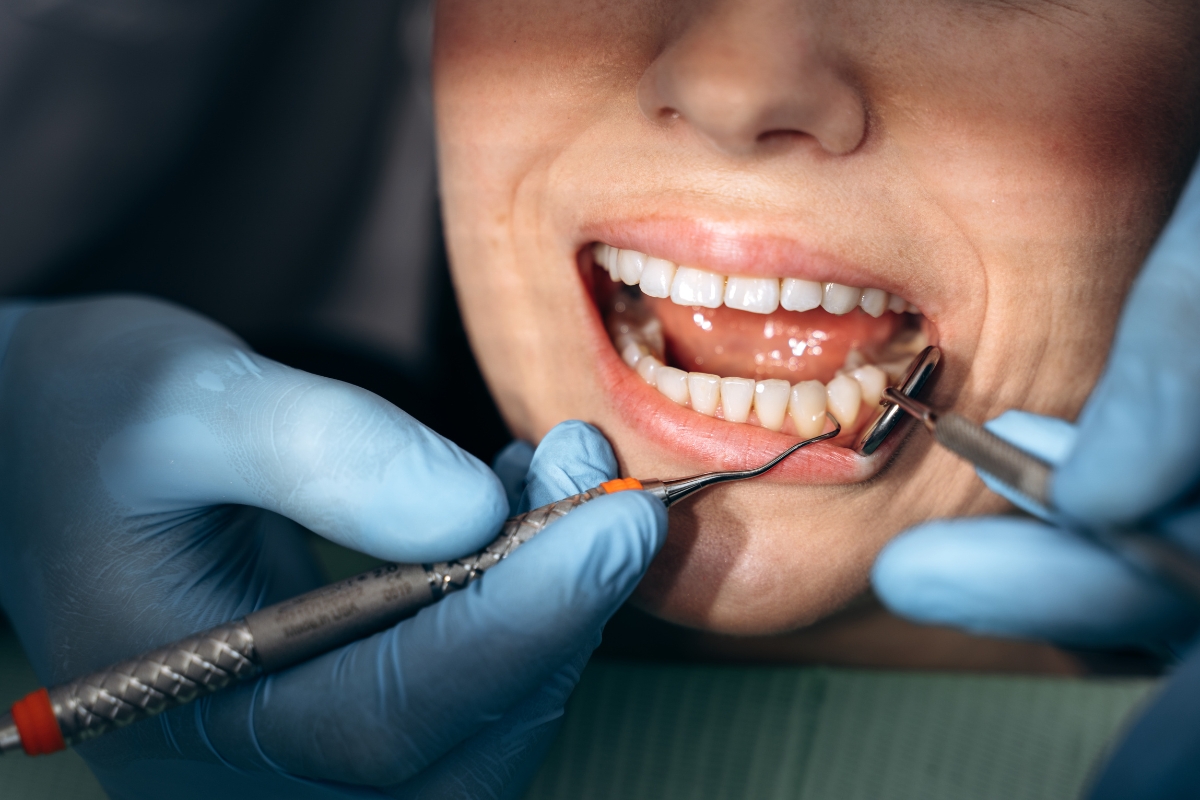
An oral cancer screening isn’t a cursory glance. Dr. Patel performs a systematic visual and tactile examination of the entire oral cavity — lips, tongue, floor of the mouth, soft palate, hard palate, gums, cheeks, and the back of the throat. This matters because tissue changes don’t always appear where a patient has noticed a symptom.
The examination includes:
- Visual inspection of all mucosal surfaces under proper lighting, looking for color changes, surface irregularities, or areas that look different from the surrounding tissue
- Palpation of the lip tissue, floor of the mouth, and neck lymph nodes to detect lumps, asymmetry, or areas of firmness
- Evaluation of the lesion itself — its size, borders, color, surface texture, and whether it’s fixed or movable
- Patient history review — including tobacco use, alcohol consumption, HPV status if known, sun exposure history (relevant to lip lesions specifically), and how long the sore has been present
If the lesion warrants further investigation, Dr. Patel can discuss next steps, which may include a biopsy referral or a follow-up appointment in a short window to reassess. The screening itself is non-invasive and takes only a few minutes during a routine dental visit.
Risk Factors That Make Screening More Urgent
Who Should Be Especially Proactive
Oral cancer doesn’t exclusively affect people with obvious risk factors, but certain factors do raise the baseline risk considerably:
Tobacco use — in any form, including cigarettes, cigars, pipes, chewing tobacco, and snuff is one of the strongest risk factors for oral cancer. Combined with regular alcohol consumption, the risk multiplies significantly rather than simply adding together.
HPV infection, specifically HPV-16, is now a well-established driver of oropharyngeal cancers — tumors of the throat, tonsils, and base of the tongue. This category of oral cancer has been increasing in incidence, particularly among adults who don’t smoke or drink heavily, which is part of why screening shouldn’t be limited to patients with traditional risk factors.
Prolonged sun exposure affects the lips. The lower lip is disproportionately affected by actinic cheilitis — a precancerous condition caused by cumulative UV exposure, which can develop into squamous cell carcinoma if not identified and treated.
A history of previous oral lesions or prior oral cancer also warrants more vigilant monitoring. Recurrence and the development of new primary lesions are a recognized pattern.
Patients in Ann Arbor and throughout Washtenaw County who fall into any of these categories benefit from making oral cancer screening a consistent part of their dental care — not a one-time consideration.
What Happens if Something Needs Further Evaluation
Clarity Is Better Than Uncertainty
One thing worth saying directly: most sores that get screened turn out to be benign. Cold sores, aphthous ulcers (canker sores), traumatic injuries, and inflammatory conditions account for the vast majority of oral lesions. Screening doesn’t create a problem — it either confirms that nothing serious is happening or identifies something early enough to act on it meaningfully.
If Dr. Patel identifies a lesion that warrants biopsy, you’ll be referred to an oral surgeon or specialist who can perform the procedure and send the tissue for pathological analysis. A biopsy is the only definitive way to determine whether cells are cancerous, precancerous, or benign. That answer, delivered early, is far more useful than prolonged monitoring with ongoing uncertainty.
A persistent sore on your lip deserves a real answer, not an indefinite wait. Dr. Patel and the team at Stadium Family Dentistry serve patients across Ann Arbor and the surrounding communities with thorough, judgment-free care. If something in your mouth has been bothering you or if you simply haven’t had an oral cancer screening recently, call the office today or book online to schedule your appointment.
People Also Ask
Can a canker sore turn into oral cancer?
Canker sores (aphthous ulcers) are benign and don’t become cancerous. However, an ulcer that doesn’t heal within two weeks, keeps recurring in the same spot, or looks different from a typical canker sore should be evaluated — those characteristics distinguish them from standard aphthous lesions.
Is an oral cancer screening painful?
No. The examination involves a visual inspection and gentle palpation of the soft tissues. It’s non-invasive, takes only a few minutes, and is typically performed as part of a routine dental checkup, with no additional discomfort.
How often should I get screened for oral cancer?
For most adults, a screening at every routine dental visit — typically twice a year — is sufficient. Patients with tobacco use, heavy alcohol consumption, HPV history, or a prior oral lesion may benefit from more frequent monitoring.
Can oral cancer develop without any symptoms?
Yes. Early-stage oral cancer is often painless, which is why visual screening by a dental professional matters. By the time a lesion becomes noticeably painful or causes functional changes, it may have already progressed significantly.
What’s the difference between a cold sore and an oral cancer lesion?
Cold sores (herpes labialis) typically appear as fluid-filled blisters, tingle or burn before appearing, and heal within one to two weeks. A suspicious lesion usually has irregular borders, doesn’t follow a predictable healing timeline, and may be painless — key differences worth noting.

By Stadium Family Dentistry

New patients and emergency appointments welcome
